
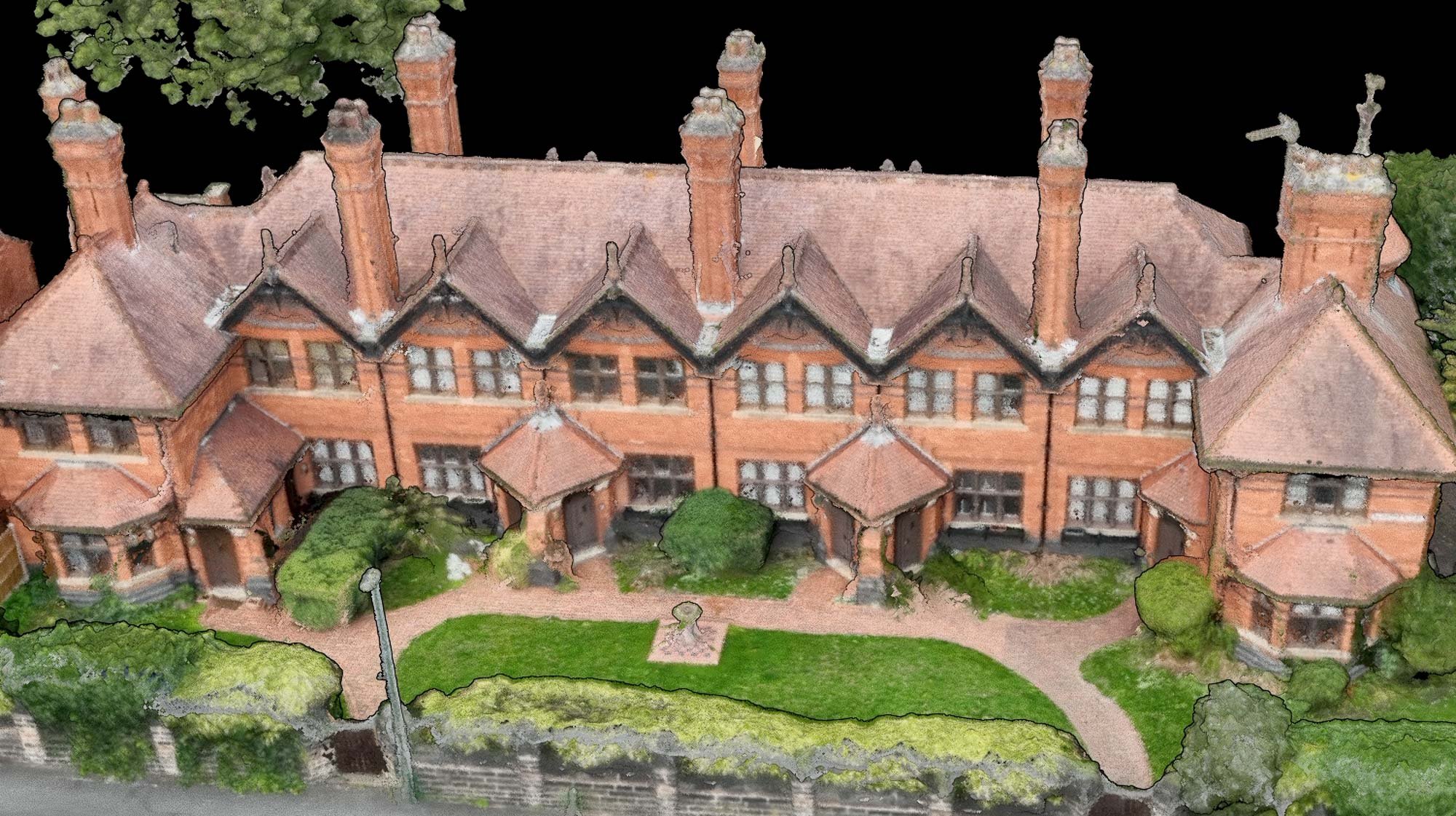
Point Cloud Roof Survey
Spatial Data for Major Building Repair Work
Overview
Client required a high resolution and high accuracy point cloud to tie in with their ground control points and ground based surveying activities.
Sector - Surveying
Output - High density point cloud with very high level of accuracy
Location - Nottinghamshire
Delivery - Oct 2025

Drone Data Capture Method
1. Office Preparation
Checked airspace restrictions and confirmed required authorisations & permissions.
Completed pre-flight assessments in line with CAA requirements.
Planned the mission route, including flight altitude, speed, ground sampling distance (GSD) and area coverage using DJI Pilot 2.
2. Pre-Flight Planning and Preparation
On site assessment: Checked the perimeter of the building carefully noting the proximity of trees and cables to the roof.
Conducted an initial reconnaissance flight to verify site conditions, safe altitude and position of control network.
Made adjustments to the survey area and altitude to ensure clear capture of the ground control network placed by the surveying team as well as safe clearance from the nearby trees.
Ensured adequate photo overlap (80/80) to give high accuracy to the final deliverables.
Connected to NTRIP network and confirmed RTK GPS fix for centimeter-level accuracy.
3. Oblique Data Capture:
The first flight was to capture oblique images around the building from multiple angles.
The location of numerous trees around the edge of the building meant that the altitude and GSD were set to safely avoid these during the capture.
4. Ortho Data Capture:
Modified the planned survey area using the DJI RC Plus 2 controller to focus on the roof of the building whilst also capturing the control work effectively.
The drone flew the automatically generated optimal flight plan after the speed, altitude and GSD were slightly modified to fulfil all aspects of the survey.
5. Post-Flight Data Processing:
Uploaded and Processed Data: Transferred images to DJI Terra.
After receiving the co-ordinates of the control network from the survey team, these were imported into Terra and tied to photo groups with accuracy adjusted as needed.
Ran initial aerotriangulation to confirm positional accuracy.
Processed the high density point cloud. .
6. Reporting and Deliverables:
Converted the LAS file into an E57 file, as required by the client, using Cloud Compare software.
Uploaded the point cloud to Nira and shared the link with the surveying client, along with the point cloud file and accuracy report.
Benefits
Comprehensive Record and Documentation
A high-resolution point cloud provides a permanent digital record at the time of survey, supporting future comparison, defect detection, claims, or planned maintenance. The data can be shared easily with clients or other stakeholders and integrated into existing digital workflows, streamlining project collaboration and documentation. The point cloud can easily be merged with ground based point clouds using the same control network, giving a comprehensive view of the entire structure.

Reduced Disruption
The non-invasive nature of drone surveys means less disruption to building occupants or ongoing site operations, as there’s no need for closures or intrusive setup.

Versatility and Analysis
The dense and accurate data enables multiple further uses, including roof plan extraction, pitch/slope analysis, defect labelling, solar panel planning, retrofit design and more.

High Accuracy and Detailed Data
The point cloud captures millions of spatial data points, enabling highly precise 3D representations, including intricate details and features often missed by manual measurements. This level of accuracy supports tasks such as creating reliable CAD or BIM models, taking off measurements, calculating areas/volumes and monitoring structural condition with minimal room for error.

Enhanced Safety and Accessibility
Drones allow surveyors to inspect roofs without physically accessing hazardous or fragile areas, minimising risks to personnel and eliminating the need for scaffolding, ladders or other expensive access equipment.

Speed and Efficiency
Drone surveys are much faster than manual methods, often capturing all necessary imagery in minutes and, through automated photogrammetry, delivering processed reports and point clouds within hours. The comprehensive nature of the data means fewer site revisits are necessary, reducing project timelines.